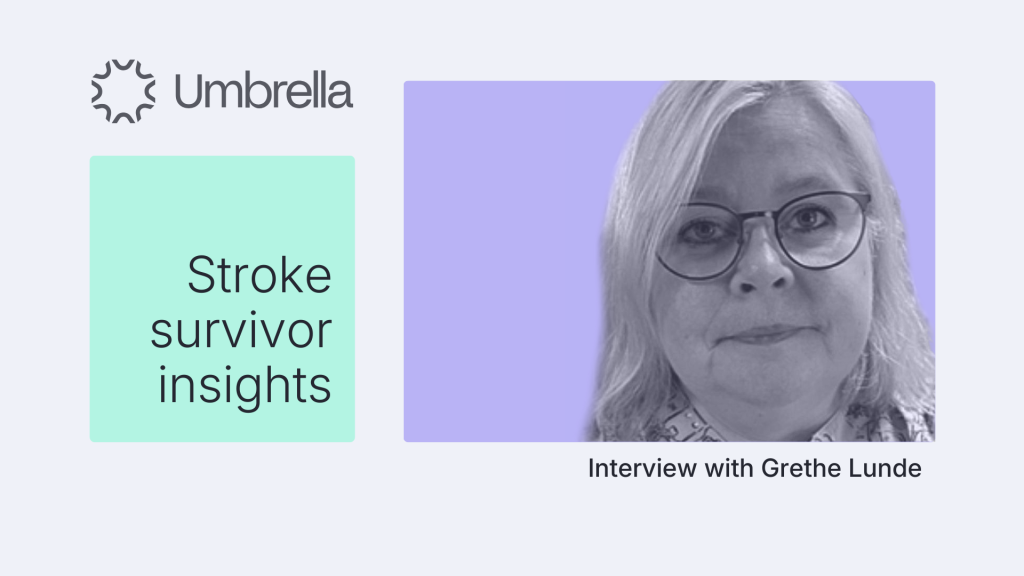
My name is Grethe Lunde and I am from Norway. I had a lifechanging stroke, a Cerebral Sinovenous Thrombosis (CSVT) in 1994 that left me in a coma for nearly two weeks. My diagnosis was set after one week in coma, by then four blood clots had formed in my brain. When I woke up I could only blink, I was left totally paralysed.
Can you tell us about the first months in your journey to recovery?
I was just 22 and couldn’t have imagined how tough it would be to regain the ability to stand, walk and get back to work. Yet, with the determination typical of someone my age, I returned to my job after about ten months on sick leave. The hardest part was learning to walk again—it took five or six months before I could even take a few steps.
Everyday tasks I’d once done without thinking suddenly became a challenge. I am grateful that I had the opportunity to relearn these essential abilities at a specialist rehabilitation centre for people with brain injuries and strokes. The staff pushed me to my limits every day, After eight weeks, I went home: I arrived in a wheelchair and left on crutches.
After this initial period, what have been the biggest challenges you have faced?
After 32 years, my biggest challenge is that I can no longer walk more than a couple of steps, but my brain still wants me to walk and exercise like I used to do! It is a hard thing to accept, but I can stand and exercise if I hold on to something sturdy.
What kind of support or information do you wish was more available to stroke patients?
In Norway, we have a great support system when it comes to occupational therapy and access to the right kind of aids. But information about spasticity and pain, especially neuropathic pain, and how these can be managed, has been lacking for me. I had to search outside of the ‘stroke world’ for pain management advice. I have often wished there was a tool to help me clearly describe to healthcare professionals how my pain feels. It wasn’t until I met an anaesthesiologist, years after the pain began and my treatment started, that I was finally given a way to do this.
Disruptive technologies like AI are transforming all fields, including healthcare. Have you heard of how it is used in stroke care?
Yes, I think it is great, if used in the right way. For example, in radiology, you can now get an earlier diagnosis thanks to AI supporting healthcare professionals ‘reading’ the scans. I have also heard how it can help identify a stroke right from the moment you call the emergency service. Time is brain so this means better outcomes for those who have a stroke in the future.
What are your thoughts on using health data and AI in stroke research and management?
As long as it is used in accordance with laws, I believe the use of AI should be mandatory in every country to help improve stroke care. It will help making it more precise, efficient, cost-effective and accessible to every stroke survivor and their families. There’s often not enough clear information about stroke and support in life after stroke, I think AI could really help fill that gap by providing useful advice and support.
In your view, what could help improve stroke research?
It is essential for healthcare professionals to continue to work together in national and international networks, sharing knowledge and stroke registries, as well as involving stroke survivors across all stages. But we also must make sure that all data and research is handled ethically and responsibly, in accordance with the law.